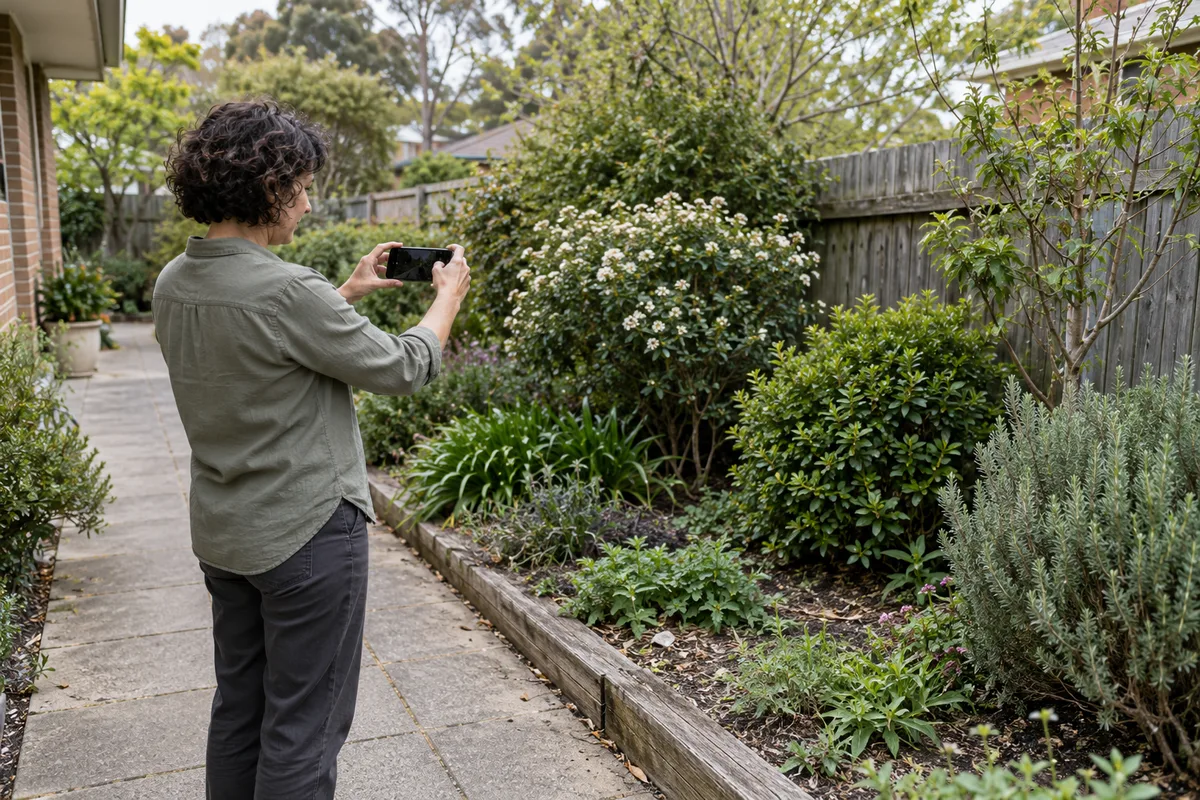
A close-up of one weed rarely explains a whole garden job. For a spring tidy-up around Bundoora, a few clear views and a short description can help show what needs attention, what should stay and where the work stops. You do not need professional photography, and photos are optional.
Green Captains offers garden maintenance within approximately 20 km of Bundoora. Photos support assessment; they do not confirm a fixed price, availability or the suitability of every task. The work and price still need to be agreed before starting.
Start with one wide view
Stand somewhere stable and take a view that includes the whole area you want tidied. For a front garden bed, include the bed from end to end and its adjoining path or lawn. For a backyard, show the particular section you want included instead of sending only a close-up of the busiest corner.
Use ordinary daylight where possible. Check that the photo is in focus and that deep shade has not hidden the ground. You can take another view from the opposite end if shrubs obscure part of the area. Stay on accessible ground; there is no need to climb, lean over a fence or move into dense growth to get a picture.
Show the boundary and what stays
Take a second view that makes the job boundary clear. A path, fence corner or garden-bed edge can be a useful reference. Describe it in the enquiry: “the bed between the driveway and the front steps”, for example. Say if the lawn or neighbouring bed is outside this request.
Point out plants you want retained, including bulbs, herbs or small plants hidden among weeds. A separate close-up can help you identify the plant you mean, but do not assume a photograph establishes its species or the right pruning method. If you are unsure what something is, say so and agree how it will be assessed before any removal.
Add a detail that changes the job
Choose one or two details that explain the main concern: growth across an edge, cuttings already piled up, or a shrub you want assessed. Pair the detail with the wide view so its location is understandable.
If there is a known obstacle, photograph it from a safe position and mention it in words. A narrow entrance, steps or an irrigation line you already know about may affect the assessment. Do not disturb unknown materials or investigate a concealed hazard just to improve the photo. For taller hedge work, use the existing hedge quote guide rather than trying to obtain a close-up at height.
Keep the photos useful and private
Review each image before sharing it. Leave out people, vehicle number plates, documents, house numbers where unnecessary, key locations and gate codes. Crop out unrelated private details without cropping away the garden context needed to understand the job. Arrange sensitive access information directly and privately when it is needed.
The current quote form includes optional job photos. Start with the clear views that explain your request rather than uploading many near-identical pictures. If you cannot take or attach photos, describe the area and ask what information is needed next. You do not need to publish your garden on social media to enquire.
Put a short brief beside the pictures
A useful enquiry combines your suburb, the result you want, the area included and anything that must stay. Mention your preferred timing as a request, and say whether you want a one-off tidy or would like to discuss regular care afterwards.
For example, adapt this fictional brief to your own property: “I am in Bundoora and would like the front bed beside the driveway weeded and tidied. Please retain the rosemary and bulbs near the steps. The lawn is outside this request. I have attached a wide view and a detail of the edge. I would prefer a weekday visit, subject to confirmation, and would like to discuss suitable follow-up care.”
If waste handling matters, mention whether a suitable green bin has room and ask about the alternative. Standard onsite cleanup is included in the agreed job; off-site green-waste removal is quoted separately. There is no need to guess the waste volume or assume removal is included.
Agree the assessment before planning the visit
Photos can show visible conditions, but they may not reveal hidden growth, ground conditions or every access constraint. An onsite assessment or more information may still be needed. Any indicative estimate is a guide until the final scope and price are agreed, and a preferred time remains a request until confirmed.
Request a garden-tidy quote with the views you have and a brief description. The aim is a shared understanding of a manageable job, followed by an agreed visit and, if useful, a discussion about ongoing care.