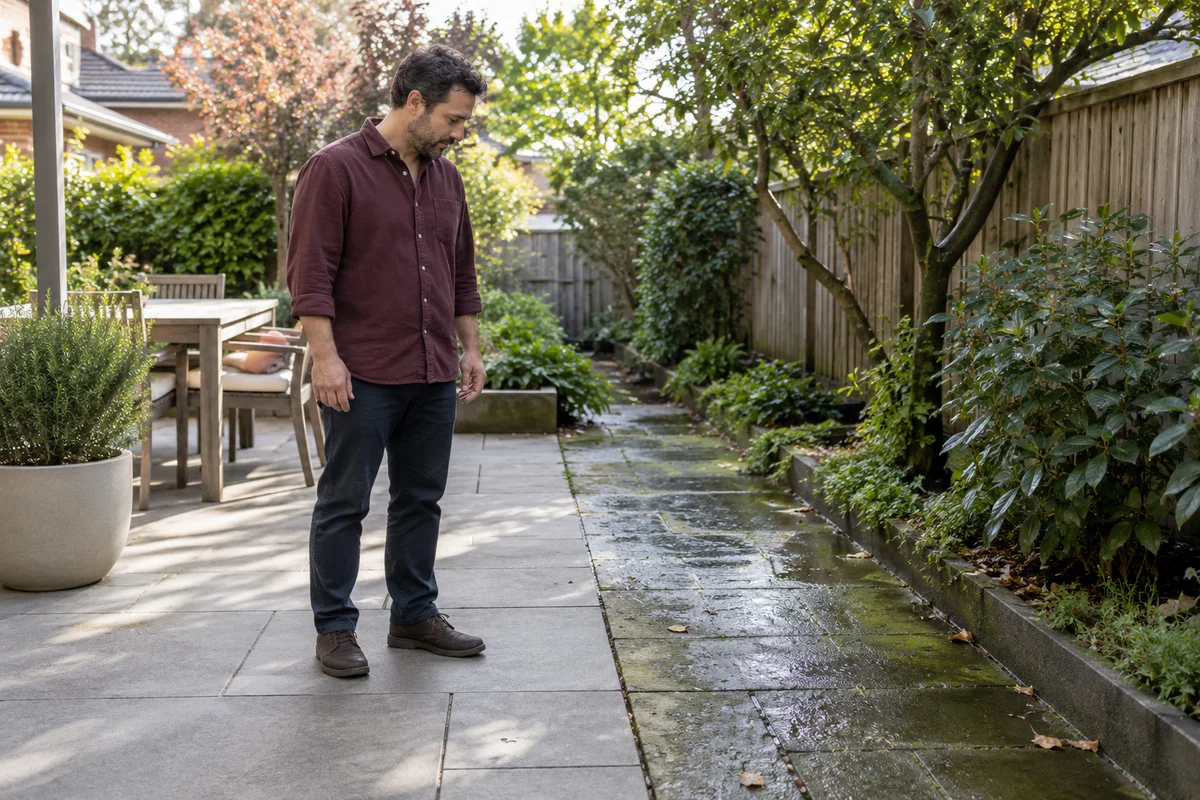
If your pavers become slippery again after cleaning, another wash may remove surface growth without changing the conditions that let it return. Start by recording where the paving stays damp, how much shade it receives and whether leaves, joint damage or standing water are visible. That gives a cleaning assessment a clearer starting point than simply asking for more pressure.
Around Bundoora, the useful question is not just “can this be washed?” It is “what can suitable cleaning address here, and what needs a separate assessment?” Do not walk onto a slippery patch to test it or assume a photograph can diagnose the cause.
A five-point observation checklist
Look only from firm, accessible ground. Leave anything you cannot safely see marked as unknown.
| What to record | Why it helps the assessment |
|---|---|
| Which section stays wet after nearby paving dries | Shows the pattern rather than assuming the whole area behaves alike. |
| Shade, nearby growth and fallen leaves | Helps describe the setting and material collecting on the surface. |
| Visible pooling or where water appears to arrive | Flags a question about water movement; it does not diagnose drainage. |
| Loose pavers, missing joint material or damaged mortar | Helps decide whether cleaning is suitable before work starts. |
| When it was last cleaned and where growth returned | Distinguishes a recurring patch from a first clean. |
A short description such as “the shaded strip beside the fence stays damp after the open patio dries” is useful even if you do not know the paving material. You do not need to name the green growth or choose a treatment yourself.
Why a clean surface can become green again
The Royal Horticultural Society explains that algae favour wet conditions, with shade and poor air circulation encouraging growth. Its hard-surface guidance notes that pressure washing can be temporary where those conditions continue. That supports checking the setting as well as the visible film; it does not establish what organism is on your path or predict how soon it will return.
Record recurring dampness over ordinary use rather than creating a test by adding water. If you notice persistent pooling, describe its location and timing from a safe position. Cleaning should not be treated as a repair for a drainage or paving fault, and adding wash water needs particular care where drainage is unsatisfactory.
Check joints and material before choosing a wash
Stronger pressure is not automatically a better answer. Paving manufacturer Marshalls warns that excessive pressure can damage paving and joints. Its guidance also discusses displaced jointing sand and damaged mortar. The appropriate method depends on the actual surface and its condition, rather than one universal pressure setting.
Mention known coatings, previous repairs and loose or damaged areas in your enquiry. Leave uncertain materials uncertain. Do not scrape joints, lift pavers or apply an unidentified chemical to prepare for a quote. Repair, re-sanding, sealing and drainage work should not be assumed to be part of a cleaning service.
Match the work to the problem you can describe
Green Captains' pressure-washing service covers suitable paths, paving and outdoor hard surfaces after condition, drainage, runoff and access checks. That assessment helps establish whether a bounded surface clean is appropriate and what it can reasonably address. It is not a promise of permanently slip-free paving or a drainage-repair service.
If loose leaves are the immediate issue, the separate leaf-litter tidy guide helps distinguish collection work from washing. For a wash, explain the surface concern first; the safe method and accepted scope are assessed rather than selected from a photograph alone.
Prepare one useful cleaning enquiry
Use this small brief:
- Area: suburb, path or patio, and approximate size if known.
- Pattern: where it stays damp and where growth returns.
- Condition: known material, loose joints, damage or coatings; say when uncertain.
- Access: gates, steps, nearby plants and a clear route to the area.
- History: previous cleaning and any recurring water issue you have observed.
Optional photos can show the whole area and the particular concern from a safe position. Avoid faces, number plates, documents and private access details. No need to stand on the slippery section for a close-up.
Request a paving-cleaning assessment with that brief. The existing private form selects Pressure Washing and accepts optional photos. Green Captains serves approximately 20 km around Bundoora; suitability, scope, price and timing are agreed before work. A preferred window remains a request until confirmed.
Sources and limits
Reviewed 22 October 2026: RHS, algae and similar growth on hard surfaces and Marshalls, product information and cleaning guidance. These UK sources support general moisture and material-care principles, not Melbourne seasonal dates, local regulatory approval or a diagnosis of your property. The generated editorial photograph illustrates the topic; it is not evidence of a real job or a surface-identification reference.